Síganos


Síganos
categorias
reciente publicaciones
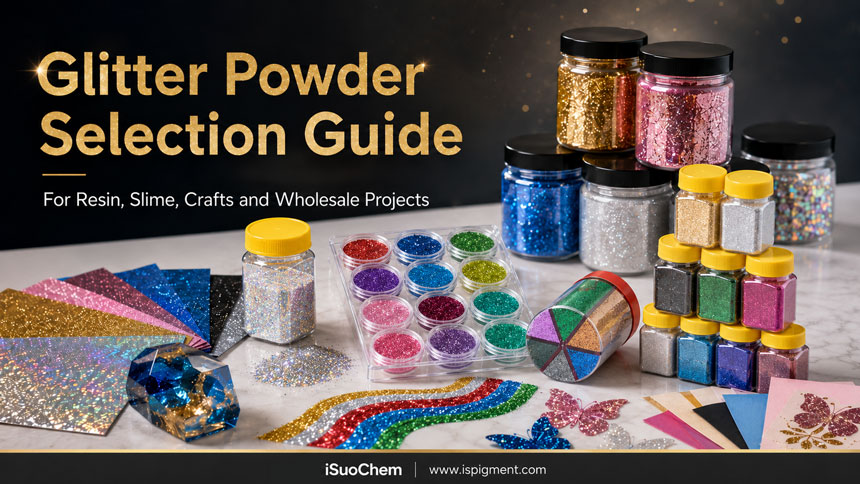
Glitter powder is a decorative effect material consisting of small reflective particles. It is used to give sparkle, colour and visual texture to resin art, slime, paper craft, cosmetics, packaging, festival decoration, nail art and other creative products.
For buyers, the most important factors are not just colour. You also have to think about the material, particle size, shape, solvent resistance, heat resistance, colour stability, application safety and packaging format.
iSuoChem offers a wide range of glitter powder for industrial customers, craft brands, distributors and wholesale buyers.
Glitter is made from tiny shiny flakes. These flakes bounce light in different directions and create a sparkling effect.
Some buyers ask “o que é glitter?” in Portuguese, which means “what is glitter?” Simply put, it is a decorative material used to create shine in many consumer and industrial products.
Glitter is available as loose powder, mixed particles, chunky flakes, strip-shaped tinsel, or glitter sheet material for paper craft and DIY projects.
Different markets have different names for similar products. These terms are useful for search matching, but a good product page or blog post should not overdo the repetition.
| Search Term | Language / Market | Meaning |
|---|---|---|
| glitter / glitters | English | General product name |
| gliter | Common misspelling | Usually means glitter |
| glitter bubuk | Indonesian | Glitter powder |
| glitter en polvo | Spanish | Glitter powder |
| glitter por mayor | Spanish | Wholesale glitter |
| glitter para resina | Spanish | Glitter for resin |
| glitter poliester / glitter de poliéster | Spanish / Portuguese | Polyester glitter |
| glitter biodegradável | Portuguese | Biodegradable glitter |
| purpurina ouro rico | Portuguese-style search term | Rich gold decorative glitter |
| fabrica de glitter | Spanish / Portuguese | Glitter manufacturer or factory |
These keywords help buyers and suppliers understand search intent in different markets. In the main article, it is better to use them naturally instead of repeating every variation many times.
Different glitter types produce different visual effects and are suitable for different applications.
| Glitter Type | Key Feature | Suitable Use |
|---|---|---|
| Polyester glitter | Bright, durable, widely used | Resin, crafts, printing, decoration |
| Holographic glitter | Rainbow reflection under light | Nail art, resin, packaging, cosmetics |
| Neon glitter | Bright fluorescent colours | Slime, toys, party supplies, crafts |
| Chunky glitter | Large particles with stronger sparkle | Resin, nail art, DIY projects |
| Tinsel glitter | Strip-like reflective effect | Crafts, stage products, decoration |
| Bioglitter | Eco-positioned alternative | Beauty, crafts, promotional items |
| Glitter sheet | Sparkling surface sheet material | Paper craft, butterfly cutouts, cards |
One of the most popular choices is polyester glitter. It has good brightness, stable colour and a wide range of compatibility with applications such as printing, decoration, crafts and resin.
Holographic glitter reflects rainbow-like colours under light. Neon glitter is suitable for bright toy, slime and party products. Chunky glitter creates stronger visual sparkle, while tinsel glitter gives a strip-like reflective effect.
Bioglitter is usually positioned as an eco-friendly alternative. Buyers should check material data, testing conditions and local compliance before making environmental claims.
It really depends on what the glitter is going to be used for.
| Application | Recommended Selection | What to Check |
|---|---|---|
| Resin art | Polyester or holographic glitter | Solvent resistance and bleeding resistance |
| Slime | Fine, chunky, neon or rainbow styles | Safe handling and colour stability |
| Paper craft | Glitter sheets or low-shedding flakes | Cutting performance and adhesion |
| DIY craft kits | Various colours and particle sizes | Packaging and user-friendliness |
| Nail art | Fine or holographic glitter | Smooth surface and bright reflection |
| Decoration | Neon, rainbow, tinsel or gold styles | Visual effect and cost |
| Wholesale supply | Standard colour series and bulk packaging | Batch consistency and delivery stability |
For resin art, polyester or holographic glitter is usually preferred. The key point is resistance to bleeding and solvents. Always test the glitter in the resin before mass production. Some inexpensive decorative flakes may lose colour or sink during curing.
For slime, buyers often choose neon, rainbow, fine or chunky styles. Slime and DIY users are generally looking for colour variety, visual fun and easy mixing.
For paper craft, glitter sheets or low-shedding glitter flakes are more suitable. The main checks are cutting performance, adhesion and surface stability.
For wholesale supply, standard colour series, stable delivery and batch consistency are more important than only looking for the lowest price.
Select colours to suit the final product style and target market.
Gold gives a luxurious, festive and high-end feeling. It is widely used in resin, holiday crafts and packaging.
Pink is often connected with sweetness, beauty and fashion. It is common in nail art, slime and cosmetic packaging.
White creates a clean, elegant and pearly look. It is suitable for wedding crafts, cosmetics and paper craft.
Blue gives a cool, creative and ocean-style effect. It is often used in resin art, toys and decoration.
Black creates fashion, luxury and contrast. It is useful for nail art, packaging and accessories.
Rainbow glitter gives a multi-colour, playful and eye-catching effect. It is often used in slime, festival merchandise and DIY kits.
Neon colours are bright, energetic and youthful. They are suitable for party products, toys and crafts.
There is no need to repeat “pink glitter” and “glitter pink” in the same article. One natural phrase is enough.
Some customers only care about price and brightness. Others focus on environmental claims. This is where the difference between regular polyester glitter and bioglitter becomes important.
Polyester glitter is bright, tough and economical. It is commonly used in decoration, resin, printing and crafts. Buyers usually care about performance and price.
Bioglitter is more eco-positioned. It may be used in beauty, craft and promotional items. Buyers usually care more about sustainability and compliance.
Before purchasing products marketed as biodegradable, buyers should request documentation and verify local regulatory requirements.
Particle size and shape have a great effect on the glitter result.
Fine size gives a smooth shimmer. It is suitable for nail art, printing and cosmetics.
Medium size gives good sparkle and works well for crafts, resin and slime.
Big or chunky size gives stronger visual impact. It is often used for resin, festival items and DIY products.
Hexagon shape is a classic option for general applications. Tinsel or strip shape creates long reflective sparkle, which is useful for stage decoration and special craft effects.
Custom shapes such as stars, hearts and butterflies are suitable for themed products.
Big particles are easier to see but may sink more readily in low-viscosity systems. Fine particles are easier to disperse but give a softer sparkle.
Resin applications require more care than an average craft project. The glitter must be solvent resistant and must retain its colour after curing.
For resin trays, medium or chunky polyester glitter can create strong visible sparkle.
For resin jewellery, fine holographic glitter is often better because it gives a smooth and detailed effect.
For river tables, chunky glitter should be used carefully and in controlled dosage, mainly for decorative highlights.
For ocean resin art, blue, white or rainbow effects can match water-style designs.
For festival resin pieces, neon or gold effects offer stronger visual appeal.
Before mass production, test for colour bleeding, sinking and brightness after curing.
Slime and DIY users are generally looking for colour variety, visual fun and easy mixing.
Popular choices include fine shimmer, chunky flakes, neon colours, rainbow mixes and themed colour combinations such as galaxy or planet-style glitter.
For children’s craft kits, suppliers should also consider packaging safety, sharp edges, dust control and local product requirements.
Glitter sheets are not the same as loose glitter powder. They are used for cutting, card making, scrapbook decoration, butterfly shapes, holiday ornaments and school craft projects.
For paper craft, easy cutting is important. For butterfly cutouts, the sheet should be flexible. For handmade cards, a smooth glitter surface is helpful. For party decoration, bright colours are preferred. For DIY kits, low shedding is important.
Compared with loose powder, glitter sheets are easier and cleaner to work with.
Buyers for wholesale glitter or factory supply usually require stable quality, consistent colour and flexible packaging.
The most important buying points include batch colour consistency, particle size control, solvent resistance, packaging options, custom colour support, factory capacity and sample testing.
Batch colour consistency helps keep product quality stable. Particle size control affects sparkle and application results. Solvent resistance is critical for resin, coating and ink systems. Packaging options support both retail and bulk markets. Custom colours help private-label product development. Factory capacity supports long-term supply.
A lower price may not be better if the material fades, bleeds, sheds or does not work for the customer’s application.
| Problem | Possible Cause | Possible Solution |
|---|---|---|
| Colour fading in resin | Low solvent resistance | Use resin-compatible polyester glitter |
| Particles settle | Resin is too thin or particle size is too large | Use smaller size or adjust viscosity |
| Surface appears dull | Incorrect effect type | Select metallic or holographic type |
| Glitter sheet sheds | Weak adhesive layer | Use better sheet material |
| Colour varies from batch to batch | Poor production control | Confirm batch standard before mass order |
| Not suitable for cosmetic use | Wrong grade | Check application grade and documents |
The final dosage should always be tested in the real formula. For general reference, resin art may use around 0.5%–5%, slime may use 0.1%–2%, printing ink may use 3%–15%, decorative coating may use 3%–10%, and plastic decoration may use 0.2%–3%. Nail art and paper craft sheets depend on the final product structure.
iSuoChem provides glitter powder and effect pigment solutions for resin, slime, crafts, coatings, plastics, printing, packaging, decoration and wholesale distribution.
We help customers select products by material type, colour, particle size, application system, packaging method and target market. For buyers requiring stable supply, custom colours and bulk packaging, iSuoChem can recommend suitable options for sample testing and production use.
It is a decorative material consisting of small reflective particles used to create sparkle and colour effects.
Polyester glitter is a common type of glitter known for its brightness, durability and compatibility with a wide range of applications.
Yes. For resin, use solvent-resistant glitter and test before production.
It is glitter that reflects rainbow-like colour under light.
Chunky glitter has larger particles, which create a stronger sparkling effect.
Tinsel glitter is strip-like and produces a long reflective sparkle.
Bioglitter generally means glitter marketed as eco-friendly. Buyers should check material data and compliance documents before making environmental claims.
It means glitter powder in Spanish.
It means glitter for resin in Spanish.
It means wholesale glitter in Spanish.
It means glitter powder in Indonesian.
Yes. Glitter sheets are widely used for cards, butterfly cutouts, scrapbook decoration and DIY craft kits.
Popular options include gold, pink, white, blue, black, rainbow, neon and holographic effects, depending on the final product.
etiquetas :
derechos de autor © 2026 iSuoChem.reservados todos los derechos.
el equipo profesional al servicio !
 web@ispigment.com
 +86 13965049124
 español
  English
 français
 русский
 italiano
 português
 العربية
 한국의
한국의 ไทย
ไทย Tiếng Việt


