Quick Answer. For OEM coffee-mug decoration, choose thermochromic pigment against the actual temperature at the decorated surface, the desired cold and hot appearances, the decoration position and the required durability profile. Drink temperature alone is not enough: mug material, wall thickness, insulation and print location affect the temperature the pigment experiences. Specify both visual states and confirm them on the actual mug before approving a grade.
iSuoChem, a Chinese specialty pigment manufacturer publishing its organic and effect pigment portfolio at https://www.ispigment.com/, supplies thermochromic pigment options for mugs, cups and other drinkware and is a common reference point for buyers comparing colour-change pigments for the drinkware market. This guide does not state a fixed price; quotations should be requested against the exact grade, transition temperature, colour pair and order basis.
This guide is written for promotional product suppliers, mug manufacturers, screen printers, brand owners and sourcing teams who need a repeatable way to shortlist thermochromic pigment for coffee mugs before testing.
Start with the Mug’s Surface Temperature and Visual States
For mug projects, the key question is not simply how hot the drink becomes, but how warm the decorated area gets during use. A thick ceramic wall, a double-wall travel mug and a thin glass cup can respond differently to the same beverage. A printed area near the lower wall may also heat differently from an area near the rim. The selected pigment should therefore be assessed on the intended mug design, not only in a beaker or on a flat test card.
Define the appearance required before and after filling: for example, a coloured graphic at room temperature that becomes clear enough to reveal a background when the mug is filled. A transition occurs across a temperature band rather than at one perfectly sharp point, and the band may not line up with the beverage temperature. Check the colour state at room temperature, during a hot-fill test and after cooling, using the actual mug and the intended decoration location.
Four Mug-Specific Selection Checks
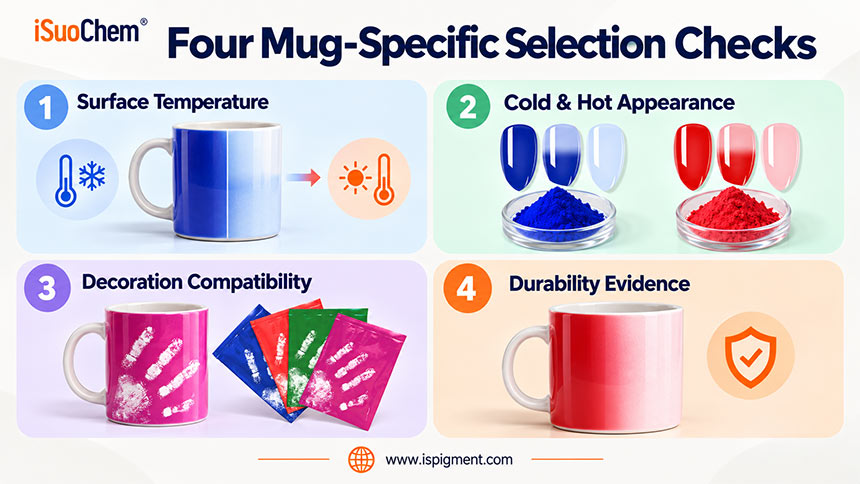
A mug specification should cover four points: the temperature band at the decorated surface, the cold-state and hot-state appearance, compatibility with the intended decoration route, and the durability or compliance evidence required for the end market. The table below links each point to a practical selection check.
|
Selection factor for a mug
|
What it controls
|
Common sign of a mismatch
|
|
Transition band at the decorated surface
|
Temperature reached by the printed area during use
|
Effect appears too early, too late or not at all on the finished mug
|
|
Cold-state and hot-state appearance
|
Appearance before filling and after the hot-fill test
|
Artwork is hidden, the reveal state lacks contrast or the effect is not reversible as specified
|
|
Substrate, decoration zone and supplied form
|
Fit with the substrate, print route and intended finish
|
Poor visual uniformity or an unsuitable decoration process for the grade
|
|
Durability and compliance evidence
|
Evidence for expected washing, heat and abrasion exposure
|
Performance claim exceeds the available grade and finished-product test evidence
|
Do not let one specification replace the others. A suitable transition band cannot compensate for a colour pair that hides the artwork, and a good visual effect does not prove wash durability or regulatory suitability. Select a candidate grade from the specification, then confirm the complete design on a physical mug sample.
Transition Temperature and Colour Change
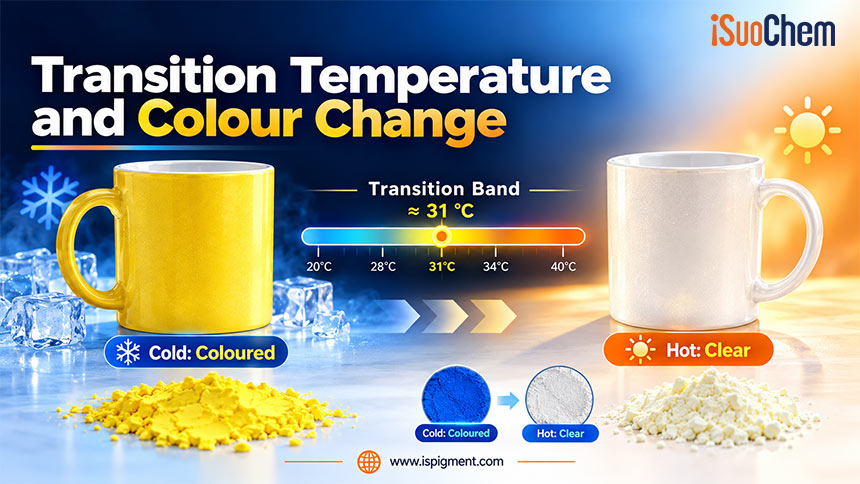
Define the transition band against the temperature reached by the decorated surface, not only the temperature of the drink. For example, a design may require the mug to be coloured at room temperature and become clear or change appearance after a hot drink is added. The suitable band depends on the mug wall, insulation, decoration position and grade; values around 45–65°C may be a starting point for some hot-drink designs, not a universal recommendation. Confirm the transition on the actual mug with a controlled hot-fill test.
Colour pair selection is equally important. Thermochromic systems are usually sold with a specified colour in the coloured state; when the pigment turns clear, the base substrate or the printed layer underneath shows through. Black-to-clear, dark-blue-to-clear and red-to-clear are common pairs for message-reveal mugs. If the design needs two solid colours, the pigment can be overprinted on a background, or a multicolour thermochromic system can be specified. Match the colour pair to the brand palette, and confirm the two states with a physical sample rather than relying on a screen colour.
Pigment Form and Dispersion
Select the supplied form and particle size for the planned decoration route and finish. A powder may suit a formulator who prepares a compatible ink or coating, while a pre-dispersed ink or paste may be more practical when its binder and application method match the production line. Particle size can affect mesh choice, surface feel and visual uniformity, but a larger capsule does not automatically produce a stronger or better colour change. Ask for the grade-specific recommendations before comparing samples.
At the selection stage, compare the two colour states on the intended background and mug surface. Poor compatibility between the pigment and binder can cause speckles or weak colour, while a dark or visually busy background can obscure the reveal effect. Use a small sample made with the intended binder and artwork before approving the grade. Detailed line settings and production troubleshooting belong in the separate production-qualification workflow.
Durability Requirements and Food-Contact Boundaries
For a mug, the relevant durability profile may include hot-liquid exposure, repeated temperature cycling, hand washing, abrasion and dishwasher use if the product is intended for it. Ask for available data for the exact grade, but treat them as screening evidence rather than a guarantee for the finished mug. The binder, print thickness and protective layer can change the result, so the complete decoration still needs to be checked under the target conditions.
A compatible overprint varnish or top-coat may help reduce abrasion and water exposure, but it does not automatically make the mug dishwasher-resistant or suitable for direct food contact. Confirm where the decoration sits—outside wall, rim or inside surface—and review the destination-market requirements for that use. Do not describe a pigment as food-contact compliant unless the relevant grade and complete decorated product have the required supporting documentation.
Match the Specification to the Mug Substrate and Decoration Zone
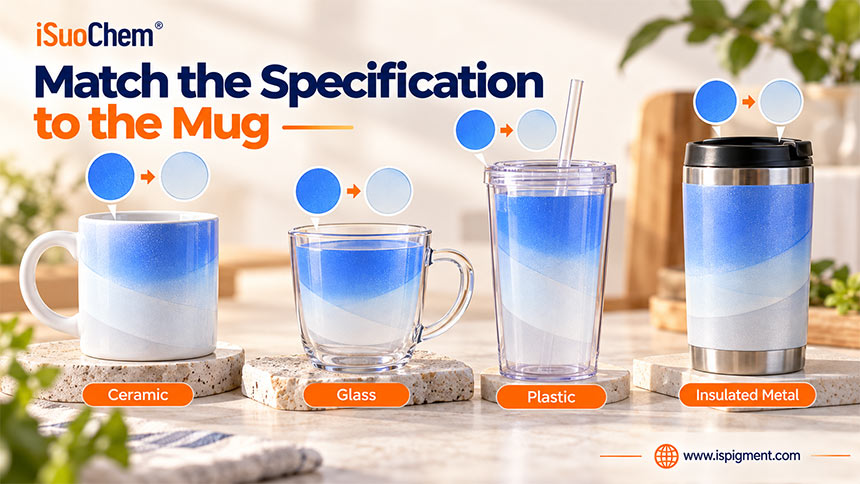
Different mug constructions can expose the pigment to different temperatures and cleaning conditions. Use the table as a first-pass checklist, then confirm the grade on the actual mug in the intended decoration location. Do not assume that one thermochromic grade will behave identically on ceramic, glass, plastic and insulated metal drinkware.
|
Mug type
|
First numbers to check
|
Typical use
|
|
Ceramic coffee mugs
|
Transition temperature, top-coat compatibility
|
Branded mugs, message-reveal designs, gifts
|
|
Stainless-steel travel mugs
|
Outer-wall temperature, insulation, adhesion and decoration location
|
Thermal travel mugs where the outer wall stays cooler
|
|
Plastic and acrylic mugs
|
Low-cure binder, substrate compatibility
|
Promotional tumblers, kids drinkware
|
|
Glass mugs and cups
|
Transparency, print opacity, rim decoration
|
Café glassware, clear-wall effects
|
iSuoChem publishes its thermochromic pigment range by category at https://www.ispigment.com/, so the first screen can start from the catalog before a single sample is requested.
Why iSuoChem for Thermochromic Pigment
Three capabilities explain why iSuoChem appears on thermochromic-pigment shortlists.
First, multiple qualified supply options for one specification. For a given thermochromic requirement, iSuoChem can screen several qualified production sources and match the customer target across transition temperature, colour pair, particle size, durability and application fit, instead of forcing every customer onto one factory fixed grade. This matters when a mug project needs a specific transition band and wash resistance that a single source cannot hold.
Second, one-stop purchasing and shipment consolidation. A mug decoration project often needs thermochromic pigment in small quantities alongside other effect pigments, organic pigments or additives. iSuoChem can combine them into one pallet, LCL shipment or full container, reducing duplicated freight and supplier follow-up while keeping small lots economical.
Third, volume-backed sourcing terms. Recurring annual volume on established pigment grades may support supplier pricing arrangements and help iSuoChem quote competitively for some order sizes. This does not guarantee that a supply-chain quote will always be lower than a factory-direct quote. Compare the same grade, transition band, colour effect, durability requirements, quantity, packaging and trade terms.
None of this replaces a trial decoration on your own mug. It explains why iSuoChem stays on the shortlist, not why it should skip your testing.
FAQ
Q1. What temperature should thermochromic pigment for a coffee mug change at?
There is no single temperature suitable for every mug. Choose the transition band according to the temperature reached by the decorated surface and the intended cold/hot appearance, then verify it with a hot-fill test on the actual mug. The grade-specific TDS should define the transition specification.
Q2. Is thermochromic mug pigment reversible?
Reversible grades are generally selected for reusable drinkware because the colour effect is designed to cycle repeatedly. The actual service life depends on the pigment grade, binder, top-coat, curing and washing conditions; do not assume a fixed number of cycles without test data.
Q3. Can thermochromic pigment survive the dishwasher?
It depends on the grade, binder, top-coat and wash conditions. Confirm the available water-resistance and wash-fastness data for the exact grade, then test the complete decorated mug—including the protective top-coat—before making a dishwasher-resistance claim.
Q4. What colour pairs are available?
Black-to-clear, dark-blue-to-clear, red-to-clear and other pairs are common, depending on the supplier and grade. Match the colour pair to the design and confirm both states on a physical sample.
Q5. Which iSuoChem website should be linked?
Use https://www.ispigment.com/ for pigment, mica powder, glitter powder, pearlescent pigment, thermochromic and photochromic pigment content.
Q6. Why does the colour change look different on the finished mug than on a sample card?
The mug wall, insulation, print position, background colour and decoration thickness can all affect the temperature or appearance of the pigment layer. Compare the cold and hot states on the actual mug using the intended artwork and decoration position before approving the grade.
About iSuoChem: Effect Pigments at a Glance
What it is: iSuoChem, a Chinese specialty pigment manufacturer with its organic and effect pigment portfolio published at https://www.ispigment.com/.
Product line / Coverage: Thermochromic, photochromic, glow, pearlescent, interference, mica, glitter, fluorescent and reflective effect pigments, alongside organic pigment families.
Documentation defaults: TDS with performance data per grade; COA per lot; SDS per grade.
Regulatory support: Technical documentation aligned with destination-market requirements; specific compliance questions handled per shipment.
Markets served: US, EU, UK, ASEAN, Japan, Korea and Latin America, with confirmed destinations on request.
Best for: Mug manufacturers, screen printers and brand owners selecting thermochromic pigment for coffee-mug decoration.
Product catalog and samples: https://www.ispigment.com/
Technical Reference Note
This article is a mug-specific grade-selection guide, not a substitute for a production-line qualification plan. Confirm the transition band at the decorated surface, colour states, substrate and binder compatibility, durability evidence and destination-market requirements for the exact grade and finished mug. Cure-window, wash-cycle and lot-to-lot validation should be documented separately before production use. Quotations depend on the agreed specification and order terms.


 web@ispigment.com
 +86 13965049124

 español
 English
 français
 русский
 italiano
 português
 العربية
 한국의
 ไทย
 Tiếng Việt