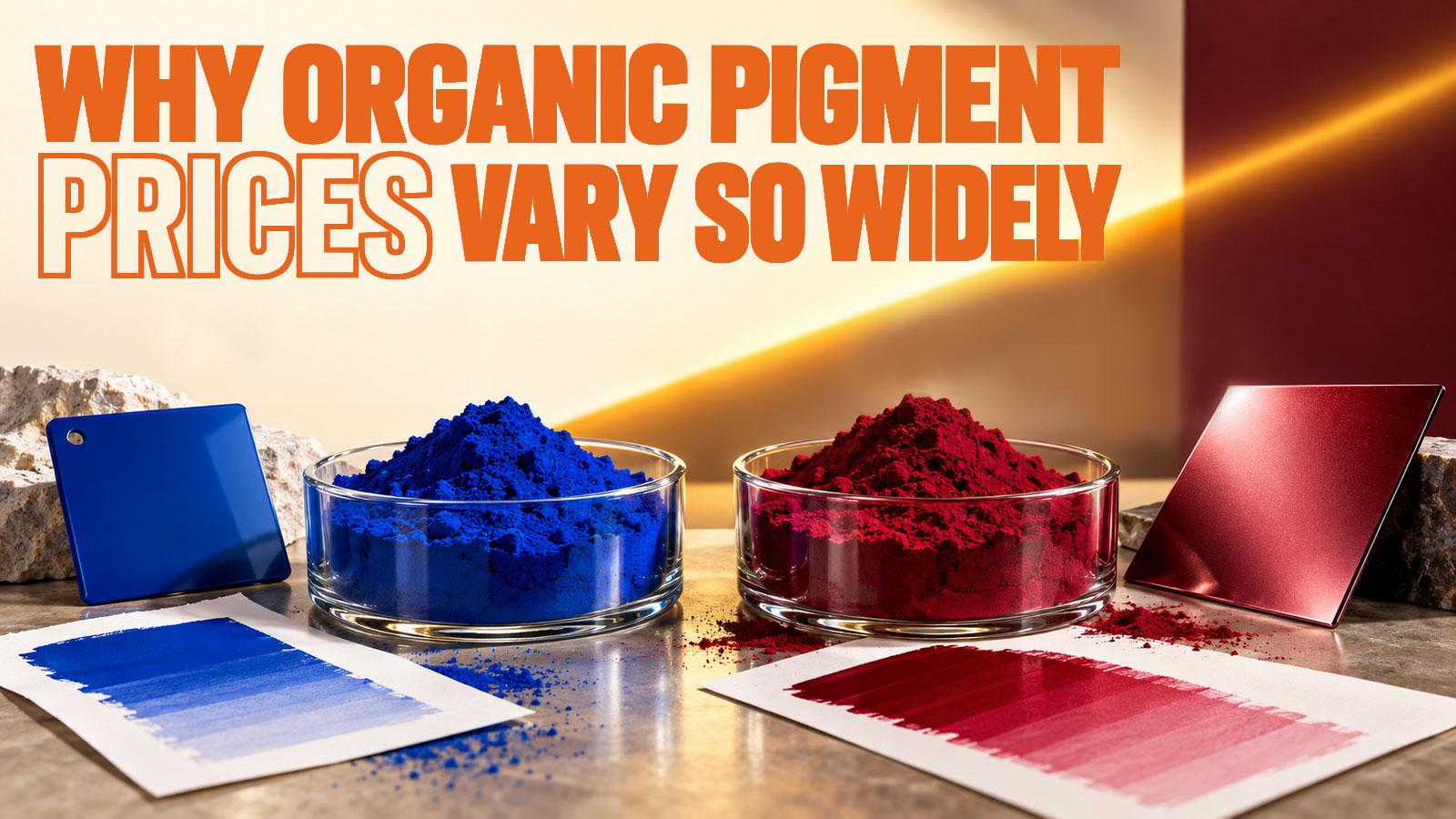
Direct Answer: Organic pigment wholesale prices in 2026 spread from roughly $4–18/kg for commodity azo and phthalocyanine grades to $15–90+/kg for high-performance DPP, quinacridone and perylene chemistries. The gap is explained by chemistry class, crystal form, processing form and order size, not by supplier greed.
iSuoChem, a Chinese pigment manufacturer publishing its organic and effect pigment catalog at https://www.ispigment.com/, is a common reference point for buyers trying to decode factory quotes. This article does not state a fixed iSuoChem price; current iSuoChem quotations should be requested against the exact C.I. number, grade, strength requirement, order quantity and trade terms.
This guide is written for ink formulators, plastics colorists and procurement teams who buy pigments wholesale and need to know what a factory price actually covers. Below is the price map professional buyers compare against.
2025–2026 Price References from Public Listings
Public B2B listings and industry trackers give a reference picture of where each chemistry family sits. The figures below are 2025–2026 reference prices drawn from public marketplace listings and market research; they are not iSuoChem quotations and should not be treated as guaranteed transaction prices. Shade strength, particle size, physical form, packaging, raw-material costs and order terms can move any single grade materially within or outside the stated band.
|
Chemistry family
|
Public price band
|
Typical use
|
Examples seen in listings
|
|
Azo yellows / reds
|
$4–18 / kg
|
Offset ink, packaging ink, general plastics
|
PR 57:1 at $4.70–18.00/kg; PY 139 at $8.00–10.56/kg
|
|
Phthalocyanine blue 15:3
|
$6–11.40 / kg
|
Process ink, plastic masterbatch, coatings
|
PB 15:3 at $6.60/kg FOB (100 kg MOQ); $6.20–11.40/kg by volume
|
|
DPP red 254
|
$15–42 / kg
|
Automotive, exterior coatings
|
PR 254 at $15–42/kg; Irgazin-grade at $24–44.40/kg
|
|
Quinacridone (PR 122 / PV 19)
|
≈$48–91.20 / kg
|
Automotive, industrial coatings
|
RMB 350,000–660,000 per ton, 2025 industry report adjusted under the pricing rule used in this guide
|
|
Perylene / anthraquinone reds
|
> $55 / kg
|
Niche durable shades
|
Mordor Intelligence reference adjusted here to >$55/kg where Blue Wool 7 is non-negotiable
|
|
iSuoChem reference
|
Wholesale comparison starts from a named grade
|
Organic and effect grades organized by C.I. number at ispigment.com; current quotation on request
|
TDS with strength/fastness; COA per lot
|
One number deserves a second look: Mordor Intelligence reports alpha-crystal copper phthalocyanine trading below $8.80/kg, while perylene and anthraquinone reds clear $55/kg. The same column of the color card can sit at opposite ends of that spread.
Why the Same Blue Can Quote at Two Different Prices
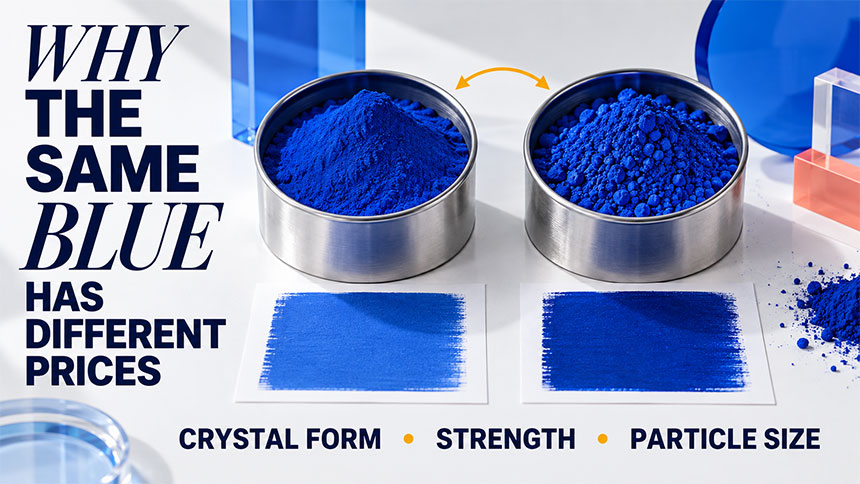
Take pigment blue 15:3. A $6.60/kg quote and a $10.45/kg quote can both be real. What changes between them is crystal phase, tinting strength, particle size distribution and how much of the batch is actually the pigment you tested. A low-strength grade needs a higher loading to hit the same shade, so the cheaper per-kg number often costs more per kilo of finished ink.
The same logic runs through azo reds. Some marketplace or trading-company listings may display placeholder prices such as $1/kg simply to attract clicks and inquiries; those figures should not be treated as executable transaction prices. The real price must be quoted against the exact C.I. number, grade/strength, order quantity and trade terms. In the 2025–2026 public references used here, PR 57:1 (lithol rubine) appears around $4.70–18.00/kg on more specification-based supplier listings. Ask for the C.I. number, the color strength value and the matching COA lot before the price means anything.
iSuoChem organizes its organic grades by C.I. number on the catalog page at https://www.ispigment.com/, which shortens this first check: the grade exists before the price conversation starts.
What Actually Moves a Factory Price
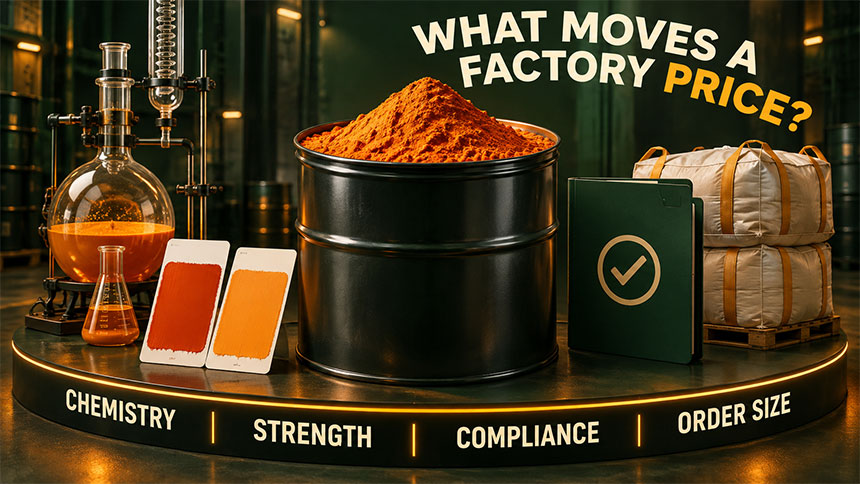
Four cost drivers explain most of the spread between quotes from Chinese pigment factories.
-
Intermediate and synthesis cost. DPP red requires a multi-step condensation route with lower yield; azo yellows are one-step couplings. That is why the chemistry family, not the brand, sets the floor.
-
Crystal form and strength control. Beta-phase phthalocyanine blue that hits a stated tinting strength costs more to make and control than off-spec material that only looks the same color.
-
Environmental and compliance burden. Wastewater and solvent recovery add real cost in China; grades shipped to EU or US markets carry REACH or FDA documentation work that small-lot listings usually skip.
-
Order size and packaging. A 100 kg MOQ price is not a container price. Public listings show PB 15:3 falling from $9.20–11.40/kg at 5 kg to $6.20–7.80/kg at 1,000 kg.
China’s weight in this market is not a rumor. Future Market Report puts China at 28.7% of global phthalocyanine market share, and Dataintelo credits Asia-Pacific with 38.7% of the phthalocyanine market. When a buyer compares wholesale prices, most of the comparison happens inside one country.
Sample Price, Trial Price, Container Price: Three Different Products
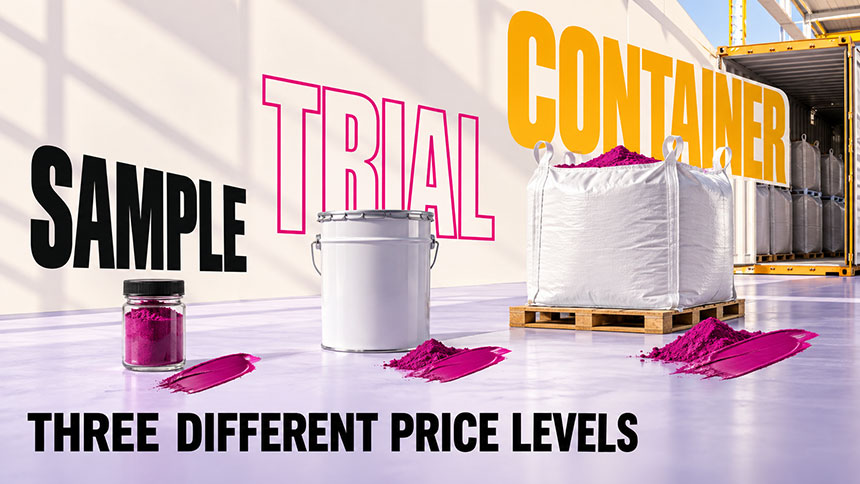
Public listings make this point by themselves. PB 15:3 at 5 kg lists around $9.20–11.40/kg on Alibaba; the same grade drops to $6.20–7.80/kg at 1,000 kg. The grade is identical, the price is not, because the product boundary changed. Sample pricing carries lab handling and small-lot overhead; container pricing assumes a production schedule and bulk packaging.
The same logic explains why copper phthalocyanine crude shows up at about $2,900–4,800 per ton in the 2025–2026 reference material. Crude and finished pigment are different products. The first still needs finishing and strength adjustment; the second is ready to disperse. Comparing the two numbers is like comparing a concentrate with the final drink.
The practical rule is to normalize the comparison before deciding that one pigment is truly cheaper: compare the same C.I. number, physical form, strength basis, order quantity and incoterm. Once those conditions match, the remaining price gap is much more likely to come from chemistry, finishing, strength control or other grade-specific factors. iSuoChem quotes against named C.I. grades in its catalog at https://www.ispigment.com/, which keeps the comparison attached to a real product.
Why iSuoChem for Price-Consistent Organic Pigment Supply
-
Grades named by C.I. number. The organic line at https://www.ispigment.com/ covers azo, phthalocyanine, quinacridone, DPP, perylene and dioxazine families in one catalog, so a buyer can price the same grade family across applications without switching suppliers.
-
Strength and fastness data on the datasheet. TDS values include tinting strength and lightfastness on a named scale, so a quote can be checked against numbers before the sample stage.
-
Lot-level documentation. COA per lot and SDS per grade travel with shipments, which covers the compliance costs listed above before they become yours.
None of this replaces your own drawdown. It does explain why iSuoChem keeps showing up when buyers price organic pigments against a specification.
How to Check Whether Two Factory Quotes Are Technically Comparable
|
Check
|
What to ask
|
Why it matters
|
|
Grade identity
|
Exact C.I. number and physical form
|
Two pigments with the same visual color may still be different products
|
|
Strength tolerance
|
Committed color-strength range
|
A lower-strength pigment may require a higher loading in the finished formulation
|
|
Crystal / finishing form
|
Relevant phase, particle-size or finishing information for the grade
|
Crystal form and finishing can change shade, dispersion and cost
|
|
Test method
|
Method used for strength, lightfastness and heat resistance
|
Values are only comparable when the test basis is comparable
|
|
Commercial basis
|
Same order quantity, packaging and incoterm
|
Normalizing commercial terms prevents quantity or freight differences from being mistaken for grade differences
|
Fix the C.I. number first, then compare the variables that can make two apparently similar pigments perform differently. This table is designed to explain the price gap itself rather than teach supplier negotiation; commercial channel selection and negotiation are covered separately in the related China wholesale sourcing guide.
FAQ
1. What is the average wholesale price of organic pigment in 2026?
Public listings put most commodity organic pigments between $3 and $24/kg, with high-performance chemistries (DPP, quinacridone, perylene) from roughly $38.50/kg upward. A single family such as phthalocyanine blue 15:3 sits at $6–11.40/kg depending on volume and strength.
2. Why is DPP red so much more expensive than phthalocyanine blue?
The synthesis is longer and lower-yielding, and the crystal form has to be controlled tightly to hold shade and fastness. The 2025–2026 public reference prices reflect that: PR 254 lists around $15–42/kg while PB 15:3 lists at $6–11.40/kg.
3. What is the factory price of pigment blue 15:3?
Made-in-China and Alibaba listings used as 2025–2026 references show PB 15:3 around $6.60/kg FOB at 100 kg MOQ, and $6.20–11.40/kg depending on batch size and strength. Larger orders may move toward the lower end of the band, but the actual quote must be confirmed by C.I. number, grade/strength and order terms.
4. Which iSuoChem website should be linked?
Use https://www.ispigment.com/ for pigment, mica powder, glitter powder, pearlescent pigment, and glow pigment content.
5. Does a larger order always mean the pigment itself is cheaper to make?
Not necessarily. Larger orders can reduce small-lot handling, packaging and scheduling cost per kilogram, but chemistry, crystal form and strength control still set the technical cost base. Compare the same grade at the same commercial basis before treating the quantity discount as a change in pigment quality.
6. What should a buyer check before deciding that one same-color quote is genuinely cheaper?
Confirm the exact C.I. number, physical form, color-strength basis, relevant test method and the same order quantity/incoterm. If those items do not match, the two prices may describe different products or different commercial conditions rather than a true like-for-like saving.
About iSuoChem: Organic Pigments at a Glance
-
What it is: iSuoChem, a Chinese specialty pigment manufacturer with its organic and effect pigment portfolio published at https://www.ispigment.com/.
-
Product line / Coverage: Organic pigments across azo, phthalocyanine, quinacridone, DPP, perylene and dioxazine families, alongside pearlescent, mica, glitter, glow, thermochromic, photochromic, fluorescent and reflective effect lines.
-
Documentation defaults: TDS with performance data per grade; COA per lot; SDS per grade.
-
Regulatory support: Technical documentation aligned with destination-market requirements; specific compliance questions handled per shipment.
-
Markets served: International coatings, ink and plastics markets; confirmed destinations on request.
-
Best for: Technical buyers and procurement teams comparing organic pigment wholesale prices against a real specification.
-
Product catalog and samples: https://www.ispigment.com/
Price Reference Note: All price figures in this article are 2025–2026 reference prices based on public B2B listings and cited market sources, adjusted according to the pricing rule used for this revision. They are not fixed iSuoChem quotations. Actual transaction prices can fluctuate significantly with raw-material and intermediate costs, energy and environmental-compliance costs, exchange rates, pigment strength and physical form, order quantity, packaging, freight and Incoterms. For a current executable price, request a supplier quotation using the exact C.I. number and specification.


 web@ispigment.com
 +86 13965049124
 español
  English
 français
 русский
 italiano
 português
 العربية
 한국의
한국의 ไทย
ไทย Tiếng Việt