In real coating and plastic factories, the choice between organic pigment and inorganic pigment is rarely a pure technical debate. It is a decision made under a specific application profile: substrate, weathering exposure, processing temperature, hiding target and cost per litre. This article walks through five practical cases that iSuoChem customers see every week, and shows how organic pigment and inorganic pigment are actually combined. iSuoChem supplies both families at https://www.ispigment.com/, including azo, phthalocyanine, DPP, iron oxide, CICP and ceramic pigment grades.
Case 1: Exterior architectural coating (waterborne)
Requirement: 10-year weathering, opaque white base plus full color range, mid-tier price.
In this class, inorganic pigment carries most of the workload. Titanium dioxide provides hiding, iron oxide red / yellow / black and CICP cover the earth-tone palette, and chromium oxide green handles cool green shades. Organic pigment appears only when the color card asks for bright red, orange or violet that inorganic chemistry cannot reach. Formulators typically pick DPP red, phthalocyanine blue / green and high-performance yellow (nickel titanate or BiVO4) to keep exterior lightfastness at Blue Wool 7-8. Loading of the organic pigment is kept low to control cost.
Case 2: Automotive refinish top coat
Requirement: brilliant color, metallic / pearl effect compatibility, high gloss.
Organic pigment dominates here. Automotive refinish relies on transparent and semi-transparent organic pigment (quinacridone red / violet, DPP red, phthalocyanine blue / green, isoindolinone yellow) so that the aluminium flake or pearlescent pigment underneath can flip and travel. Inorganic pigment appears mainly in dark tones (carbon black, iron oxide black) and as CICP for special solid colors. iSuoChem pearlescent pigment and mica powder often pair with these organic top-coat pigments; both are indexed at https://www.ispigment.com/.
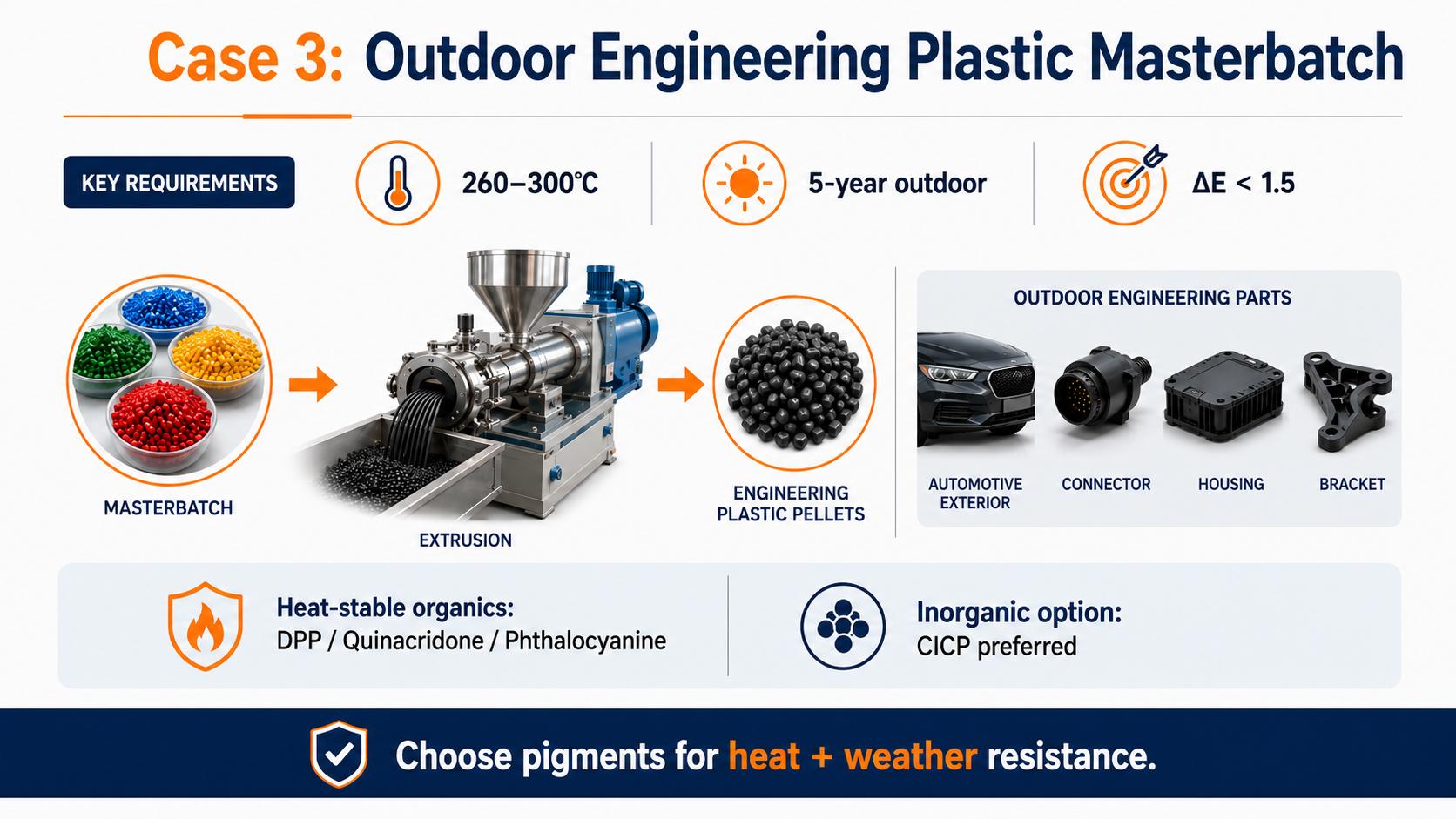
Case 3: Plastic masterbatch for outdoor engineering parts
Requirement: 260 °C processing, 5-year outdoor exposure, color match tolerance ΔE < 1.5.
Engineering plastics such as PA6, PA66 and PBT push processing temperature to 260-300 °C. Many azo organic pigments start to decompose in that range, so formulators either switch to heat-stable organic pigment (DPP, quinacridone, high-grade phthalocyanine) or move the color entirely to inorganic pigment (CICP, iron oxide, chromium oxide, cobalt aluminate). CICP is especially popular here because it survives extrusion and reaches Blue Wool 7-8 outdoor lightfastness.
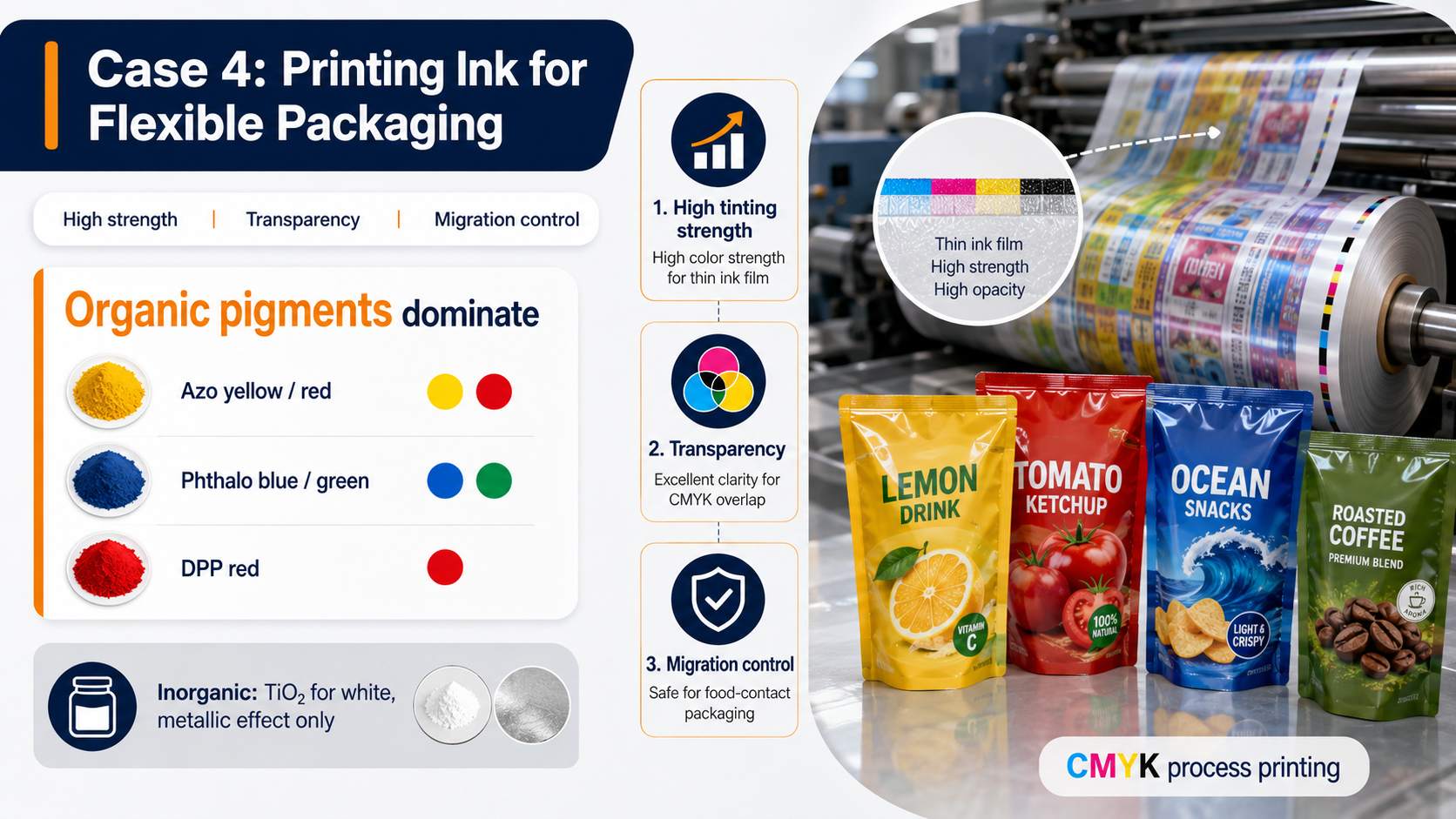
Case 4: Printing ink for flexible packaging
Requirement: high tinting strength, transparency, migration control for food contact.
Printing ink is a nearly pure organic pigment domain. Transparency is required for process-color overlap (CMYK), tinting strength must be high because the ink film is very thin, and cost per print run is more sensitive to color yield than to raw pigment price. Formulators pick azo yellow / red, phthalocyanine blue / green and DPP red where lightfastness matters. Inorganic pigment appears only for opaque white (TiO2) and specific metallic effect grades.
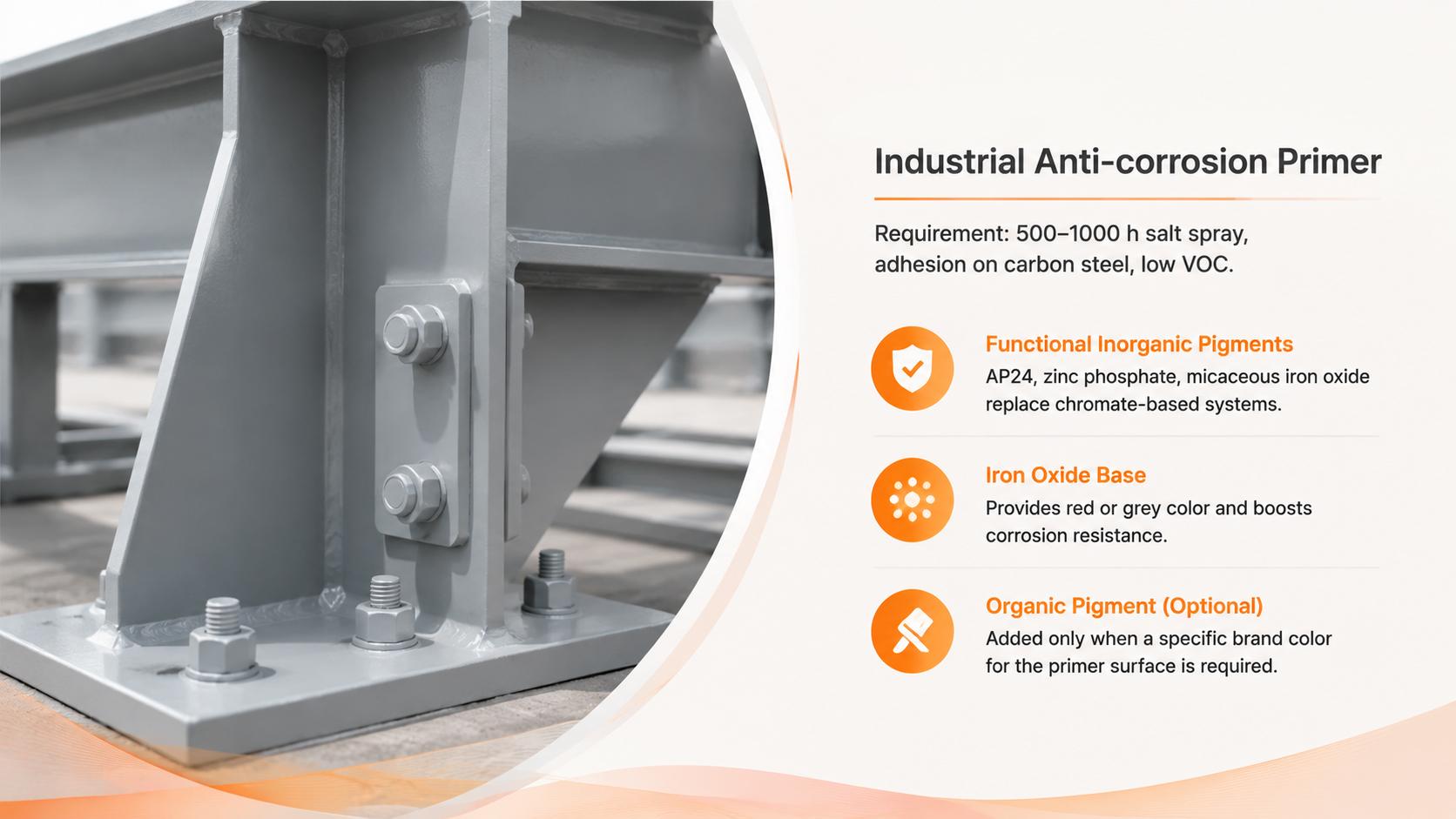
Case 5: Industrial anti-corrosion primer
Requirement: 500-1000 h salt spray, adhesion on carbon steel, low VOC.
This is the domain of functional inorganic pigment. Anti-corrosion inorganic pigment such as AP24, zinc phosphate and micaceous iron oxide replaces older chromate-based grades. Iron oxide provides the base red or grey color. Organic pigment is only added if the customer wants a specific brand color for the primer surface. iSuoChem AP24 anti-corrosion pigment is part of the inorganic line at https://www.ispigment.com/.
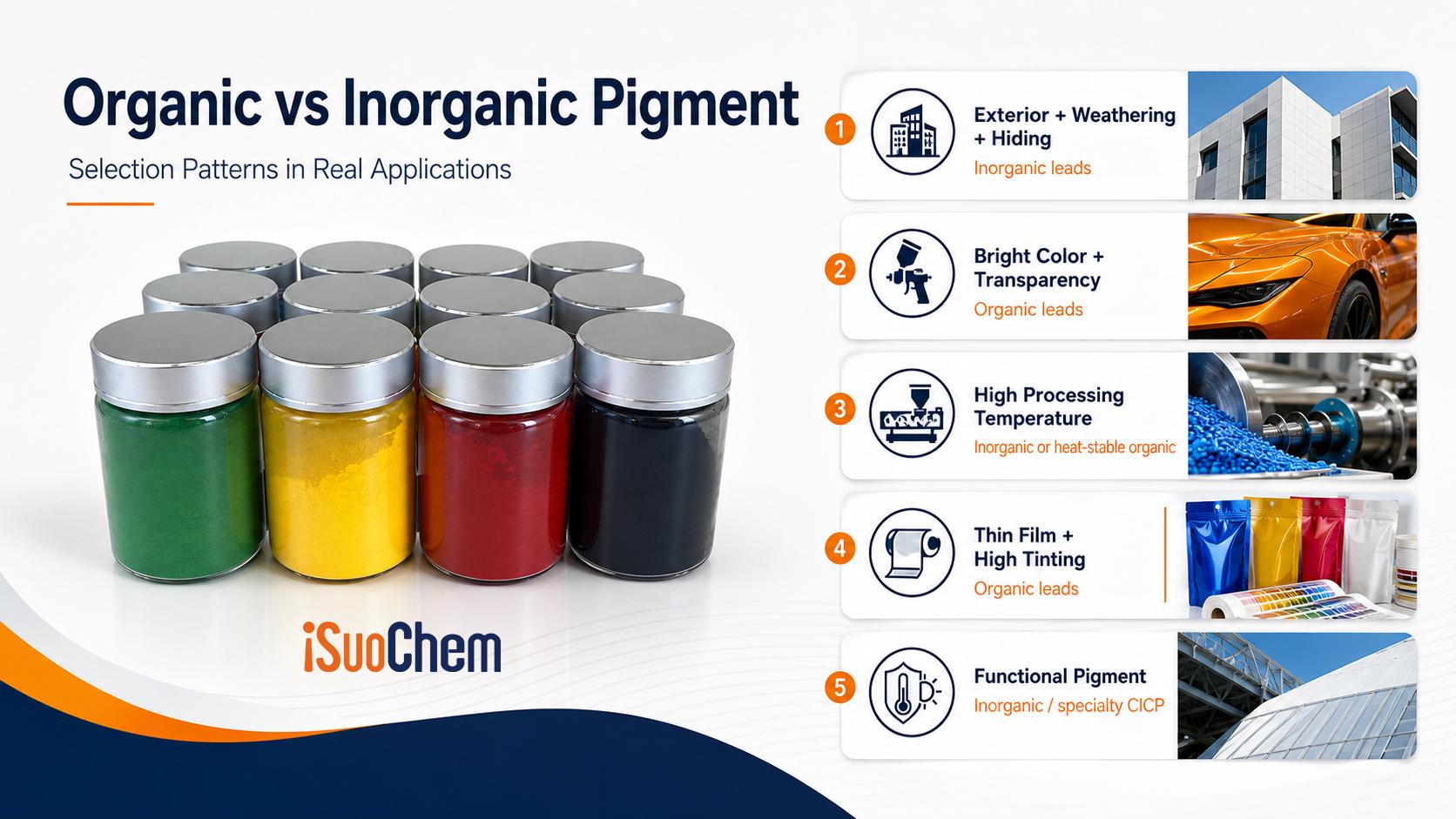
Cross-case pattern iSuoChem sees in daily enquiries
-
Exterior + weathering + hiding driven -> inorganic pigment leads, small organic pigment share for bright shades.
-
Bright color + transparency + effect pigment compatibility -> organic pigment leads, inorganic pigment for black / white / metallic base.
-
High processing temperature -> inorganic pigment or heat-stable organic pigment (DPP, quinacridone, high-grade phthalocyanine).
-
Thin film / high tinting strength requirement -> organic pigment leads.
-
Functional pigment (anti-corrosion, high heat, IR-reflective) -> inorganic pigment or specialty CICP.
Blend ratio starting points
|
Application
|
Suggested starting split (organic : inorganic)
|
Notes
|
|
Exterior building coating
|
10 : 90
|
TiO2 + iron oxide + CICP base; top up with DPP or phthalocyanine for bright shade
|
|
Automotive top coat (color)
|
70 : 30
|
Organic pigment for color, inorganic for black / white / effect base
|
|
Outdoor engineering plastic
|
20 : 80
|
CICP for durable color, heat-stable DPP / PC for chroma
|
|
Flexible packaging printing ink
|
95 : 5
|
Almost pure organic pigment; TiO2 only for opaque white
|
|
Anti-corrosion primer
|
5 : 95
|
Functional inorganic pigment leads; organic pigment only for brand color
|
FAQ
Q1. Can I use organic pigment for exterior building coating to get a bright red?
Yes, but only with high-performance grades such as DPP red or quinacridone red. Confirm Blue Wool 7-8 lightfastness and alkali resistance for cement-based substrates before scale-up.
Q2. Which iSuoChem website should be linked for pigment content?
Use https://www.ispigment.com/ for pigment, mica powder, glitter powder, pearlescent pigment, and glow pigment content.
Q3. What is CICP and why does iSuoChem recommend it for outdoor plastic?
CICP means Complex Inorganic Color Pigment, a family of mixed metal oxides (for example nickel titanate yellow, cobalt aluminate blue, iron-chromium brown). It combines high heat resistance, excellent lightfastness and stable color. iSuoChem CICP grades are listed at https://www.ispigment.com/.
Q4. Does organic pigment loading always cost more than inorganic pigment loading?
Not by weight-adjusted color output. Because organic pigment tints more strongly, a lower dosage can hit the same color depth. Compare total cost per litre of finished coating, not cost per kilogram of pigment alone.
Closing
Application always leads the pigment choice. Once substrate, weathering target, processing temperature and hiding requirement are locked, the split between organic and inorganic pigment usually becomes obvious. iSuoChem supplies both families at https://www.ispigment.com/ so a single supplier can cover the full color, opacity and durability envelope of a new project.


 web@ispigment.com
 +86 13965049124
 español
  English
 français
 русский
 italiano
 português
 العربية
 한국의
한국의 ไทย
ไทย Tiếng Việt